Start With the Arbitration Clause
Before a dollar of acquisition spend, the respondent's published terms have already set the campaign's fees, forum, exits, and evidence burden. Reading them like an operator is phase zero — and the last three years of court records list the campaigns that didn't.
Managing Mass Arbs · Part I of V
The phase at a glance
| Subject | Phase zero of every mass arbitration — reading the respondent's published dispute-resolution terms like an operator, before a dollar of claimant acquisition is spent |
| The terrain | The clause features that set a campaign's fees, forum, timeline, exits, and evidence burden in advance |
| The clock | Sixty days of informal resolution before any demand may be filed — Temu, Uber, AT&T, Discord, and Stripe all run the same timer |
| Field examples | Temu, Uber, AT&T, Google, OpenAI, Ticketmaster — published terms and the court records they produced |
| The stakes | Wallrich (~50,000 claims), McMahan (~20,000), and Heckman (an entire clause) were each decided by terrain features visible in the terms before filing |
| Status | Every feature below sits in documents anyone can read today |
The story
The first document in any mass arbitration campaign is written by the other side.
Before the legal theory, before the ad spend, before the first retainer, the respondent's terms of service have already decided most of the campaign's economics:
- Forum and rules: which administrator hears the claims, under which rulebook
- Fee timing: when fees accrue, and who bears them
- Preconditions: what must happen before a demand may be filed
- Escape valves: which claims can exit to small-claims court
- Evidence: what the whole structure will demand, per claimant, when it is tested
Firms that read the clause as a formality discover these terms in year two, from opposing counsel. Firms that read it as terrain make their go/no-go decision, and their budget, before signing claimant one.
The last three years of court records read, among other things, as a list of campaigns that met a clause feature late:
- ~50,000 Samsung claims dismissed on evidence the forum's rules required 8
- ~20,000 Temu claims ended by a precondition and its carveout 1
- One entire arbitration clause struck because the respondent's anti-mass-arbitration design overreached 9
All of it was readable in advance.
The terrain, at a glance
| Feature | Published example | What it decides |
|---|---|---|
| Notice + precondition | Temu § 19.2; Uber; AT&T 123 | Whether filing day exists at all — and when |
| Who decides preconditions | Temu § 19.7 (courts only) 1 | Which referee hears the threshold fight |
| Batching mechanics | Temu (100); Google (25+); OpenAI (25, batches of 50) 145 | Per-claimant fee leverage |
| Fee triggers | AAA schedule; respondent-pays norms 67 | When the meter starts, and on whom |
| Forum + rules | AAA consumer vs. NAM vs. private protocols 59 | Fee schedule, Process Arbitrator powers — and public visibility |
| Small-claims carveouts | Google; OpenAI 45 | An escape valve that reprices small claims |
| Opt-out windows | Google; OpenAI (30 days) 45 | Whether a court option was preserved — briefly |
| Mass-arb protocols | Ticketmaster/New Era (struck) 9 | Whether the clause itself survives |
| Implied evidence burden | Wallrich; McMahan 18 | What the proof file must contain at intake |
Five minutes with the terms settles most of a campaign's fate. The tour:
The doorway, and who guards it
Start where Part II of this series lives: a growing family of clauses — Temu, Uber, AT&T, Discord, Stripe among them — makes an individual, personally-attended, good-faith conference a condition precedent to any demand 123. The industry has converged on the same clock: sixty days of informal resolution before any demand may be filed 123. If the target's clause has one, the campaign has a logistics phase before it has a filing date, and every claimant's reachability becomes a legal requirement. Part II runs that phase in full.
The subtler feature sits beside it: who decides whether the precondition was satisfied.
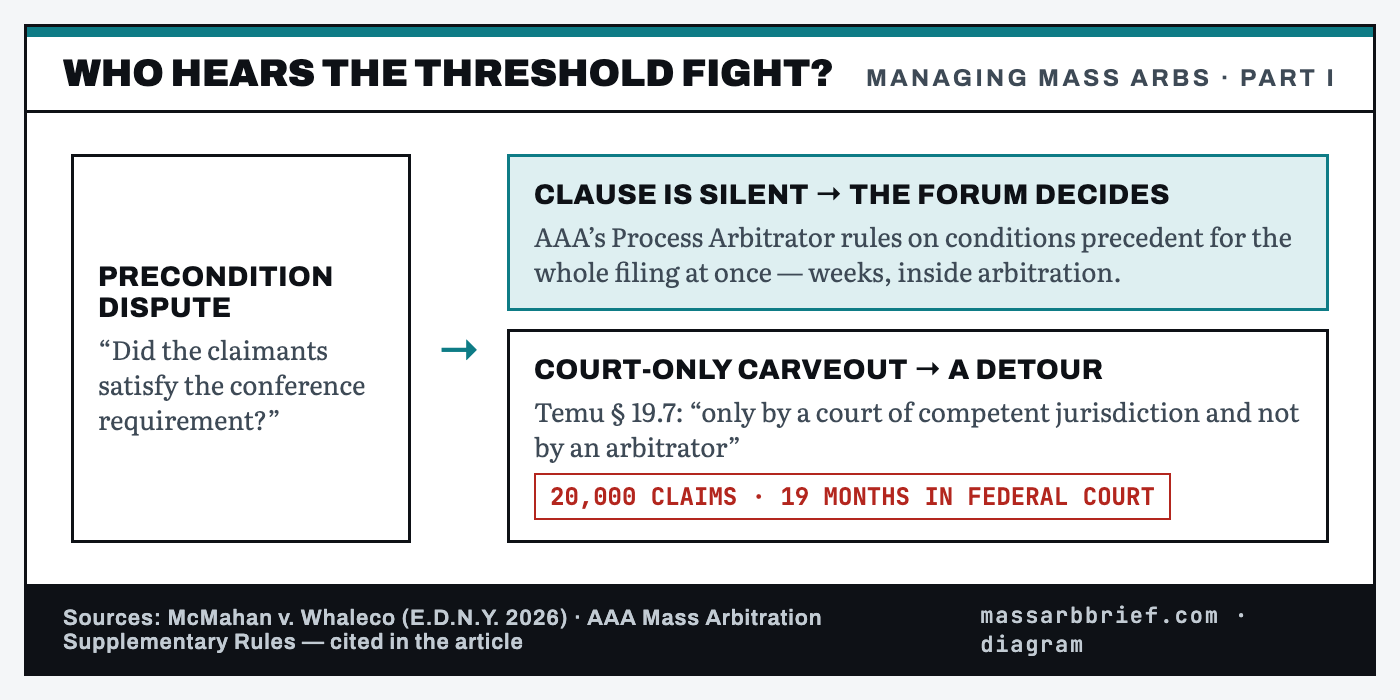
Temu's § 19.7 carves that question out of arbitration entirely — "only by a court of competent jurisdiction and not by an arbitrator" 1 — and that single sentence routed a 20,000-claim campaign out of AAA and into nineteen months of federal litigation. Clauses that stay silent leave the question to the forum, where AAA's Process Arbitrator rules on conditions precedent for the whole filing at once 10. Same defect, different referee, completely different campaign arc. The routing is printed in the terms.
The meter: when does the money move?
Mass arbitration's settlement pressure was built on per-case fees. The newer clause generation is built on managing them, and batching is the main tool:
- Temu batches 100 similar demands to one arbitrator and one fee set 1
- Google's June 2026 Ads revision batches at 25 4
- OpenAI groups commonly-represented claimants into batches of up to 50 5
Each batch provision divides the respondent's per-claimant exposure, and the claimant side's fee leverage, by the batch size.
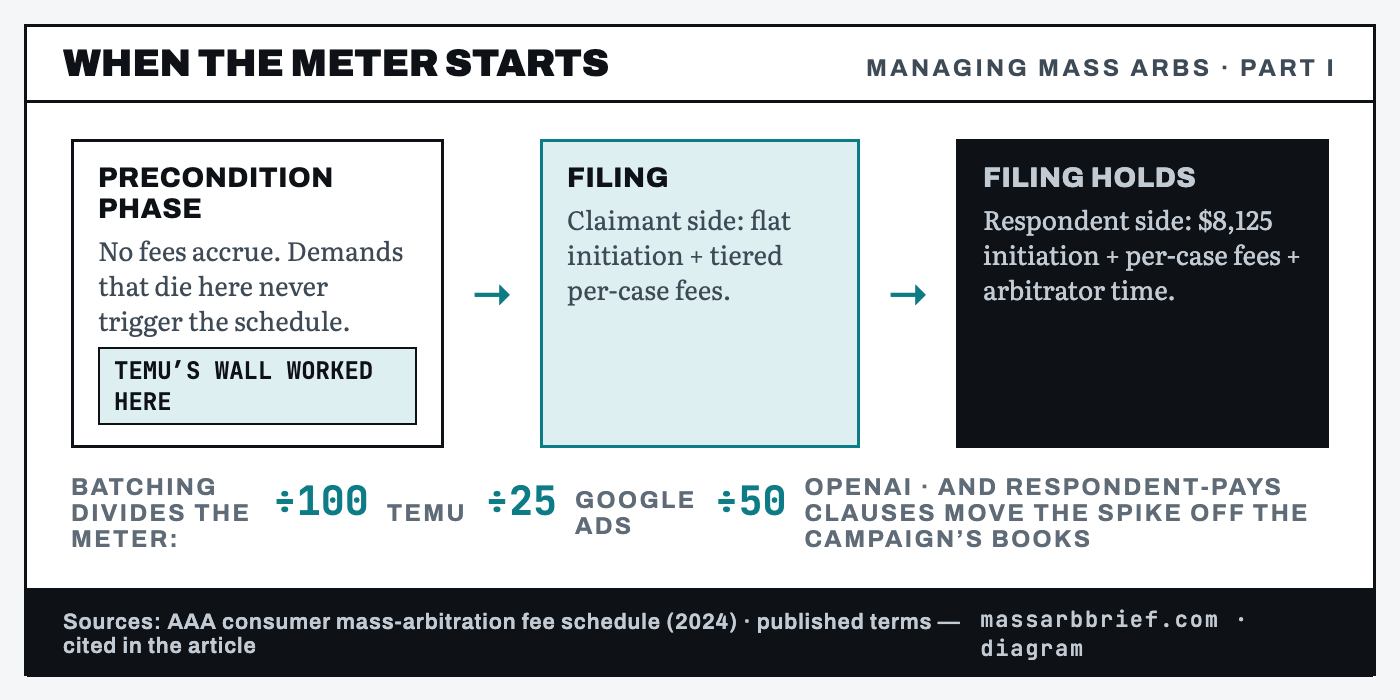
The second question is the trigger. Under AAA's consumer mass-arbitration schedule, the claimant side's flat initiation fee and tiered per-case fees land at filing; the respondent's much larger side ($8,125 initiation, per-case fees, arbitrator time) lands when the filing holds 6.
Demands that die at a precondition never trigger fees at all — Temu's wall worked before the meter started 1. And many consumer clauses assign arbitration costs to the company outright, which moves the spike off the campaign's books entirely 7. The same campaign, under two different clauses, can carry a filing-day cash cliff or none.
The map: forum and rules selection
The clause names the administrator, and the administrator decides more than logistics.
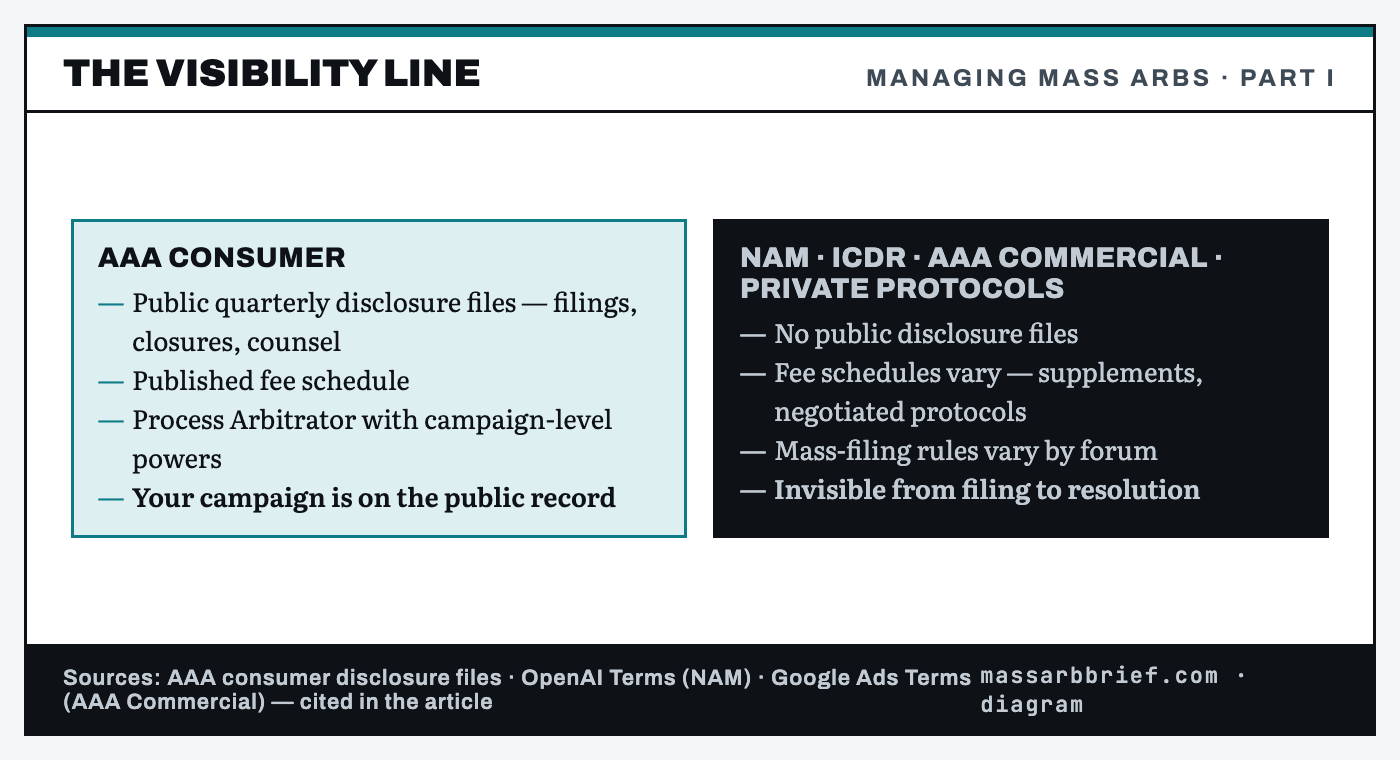
AAA consumer rules mean the Process Arbitrator's campaign-level powers 10, a published fee schedule 6, and public disclosure files — which is why this publication can see AAA campaigns at all. OpenAI's terms route disputes to National Arbitration and Mediation (NAM) 5; Google's 2026 revision moved advertiser disputes from the International Centre for Dispute Resolution (ICDR) to AAA's commercial rules 4.
Different rulebooks mean different fee schedules and different mass-filing provisions. Some of these forums publish no consumer disclosure data, so a campaign there is invisible to the public record from filing to resolution. The forum line in the clause decides whether your campaign's story can ever be independently verified.
The exits
Two features preserve court options and reprice small claims.
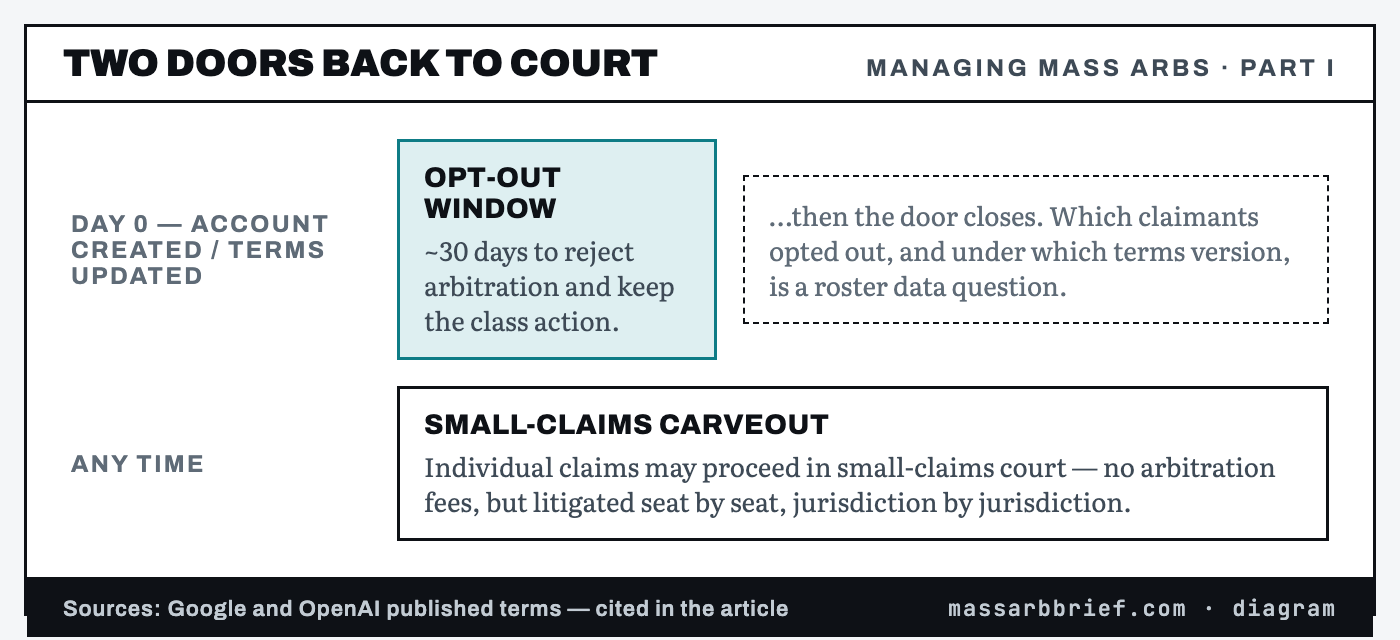
First, the small-claims carveout: Google's and OpenAI's clauses, like many, let individual claims proceed in small-claims court 45. Respondents began invoking these affirmatively in the DoorDash era. For claimant operators the carveout cuts both ways: a court path with no arbitration fees, but one that must be litigated seat by seat, jurisdiction by jurisdiction.
Second, the opt-out window: thirty days, typically, from account creation or terms update, to reject arbitration entirely and preserve the class action 45. For an operator this is mostly timing history, and version-dating the terms (the Wayback Machine is an underrated litigation tool) tells you which claimants live under which clause. Do you know, today, which terms version each claimant on your roster signed under?
The ceiling: when the clause overreaches
The clause read runs in both directions; the final question is whether the respondent's design survives its own ambition.
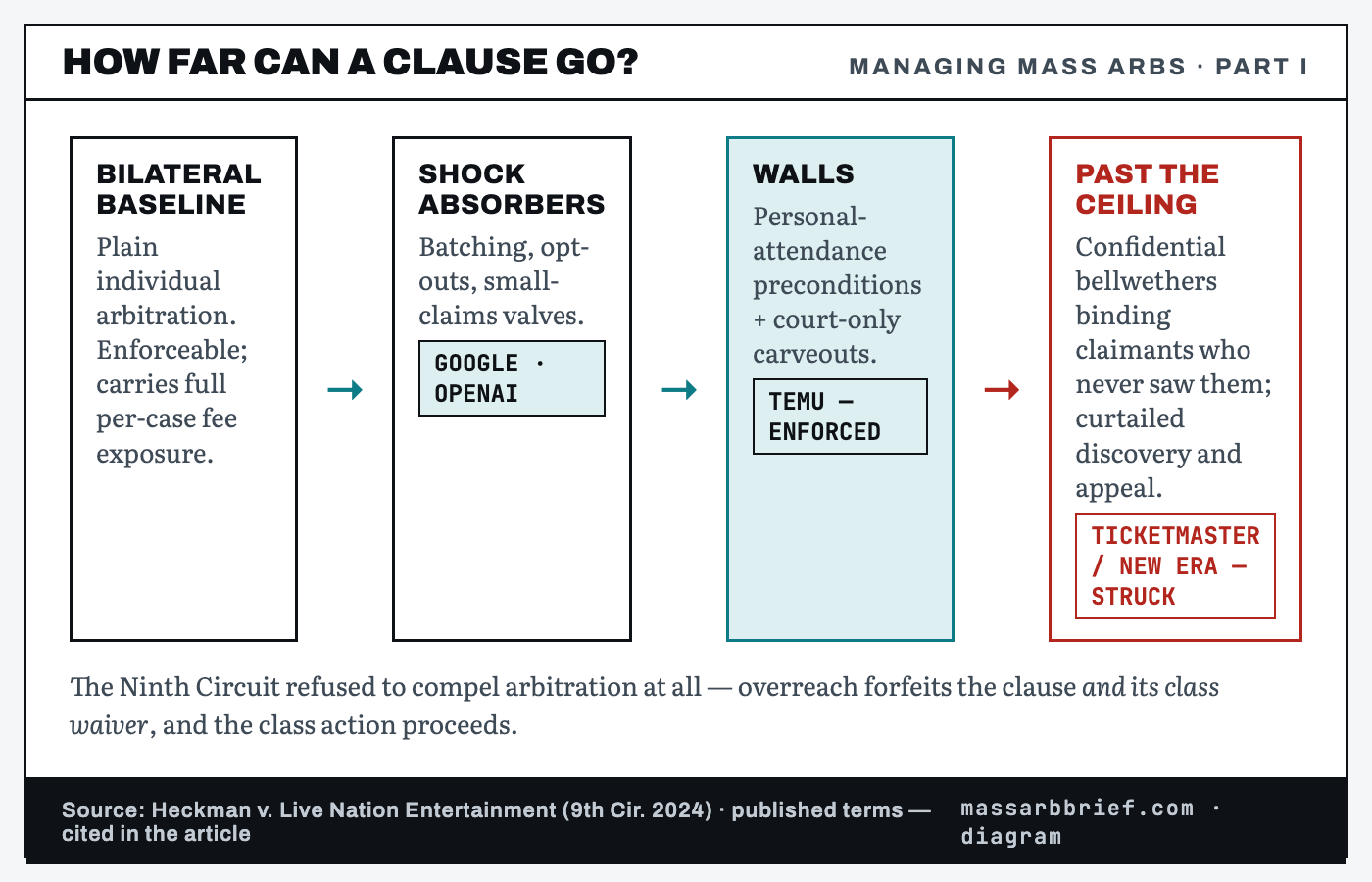
Ticketmaster and Live Nation routed disputes to New Era ADR under "mass arbitration" protocols: batched claims, three confidential bellwether cases binding on all claimants, including those with no opportunity to participate in or even read them, with curtailed discovery and appeal. In October 2024 the Ninth Circuit held the whole arrangement unconscionable and refused to compel arbitration at all; the class action proceeded 9. Defense alerts drew the lesson their clients now draft by: anti-mass-arb engineering that fails to preserve real bilateral arbitration can forfeit the arbitration clause, and its class waiver, entirely 9.
For the operator, Heckman means the terrain read includes a constitutional-style question: is this clause enforceable as written? A clause aggressive enough to fail is not a wall; it is a door back into court, and a campaign that spots the overreach early can choose its forum fight accordingly.
What the clause implies about evidence
Every feature above converges on the least glamorous line of the read: what will this structure demand that you prove, per claimant, when tested? The clause read produces, as its most valuable output, the specification for the proof file — the checklist of what intake must collect on day one because a Process Arbitrator, or a district judge, will ask for it in year two:
- Agreement to arbitrate under the operative version of the terms — the failure that ended ~50,000 Samsung claims when counsel could not produce it 8
- Identity and account details sufficient for the notice requirements
- Usage or purchase facts the claim form and forum rules require
- Personal attendance records where a precondition demands them 1
Wallrich died on the first item. Could your intake files produce it today, for every claimant?
The operator's takeaway
Plain terms — the clause read as a phase with deliverables:
- Read: every feature above, from the current version of the terms and the versions your claimants actually signed under. An hour of reading; version-date it; archive it.
- Decide: the read is a go/no-go gate. A court-only precondition carveout, an aggressive batching provision, and a NAM-style forum are not reasons to quit — they are inputs that reprice the campaign before it exists. Some clauses, read honestly, price a campaign out; better to learn that before the ad spend.
- Price and spec: the read feeds the model directly — the respondent-pays toggle, the dismissal-risk preset, the compliance budget for preconditions, the batch divisor on fee leverage — and it writes the intake team's evidence checklist. The clause, not the complaint, is the first operational document of the campaign.
Mass arb requires more than just signing a client — and the proof starts on a page the other side wrote.
Open questions
- Which school wins the redraft? Post-Heckman, respondents face a live design choice between Temu-style walls (preconditions + carveouts) and Google-style shock absorbers (batching + opt-outs + small-claims valves). Which direction the next wave of terms revisions takes is the category's most consequential unwritten story — we track versions.
- Who actually does the read? At the firms running these campaigns, is the clause reviewed by the partner, an associate, or nobody until opposing counsel does it for them? Our line is open — anonymously if preferred.
Next in the series — Part II: the pre-filing conference at claimant scale.
Sources on file
- McMahan v. Whaleco, Inc., No. 25-cv-1590 (E.D.N.Y. Mar. 9, 2026), Memorandum & Order (Brodie, J.)
- Uber Technologies, U.S. Terms of Use — arbitration agreement
- AT&T Consumer Service Agreement — dispute resolution terms
- Google Ads Terms of Service revision (June 2, 2026) — AAA Commercial rules, 30-day opt-out, small-claims carveout, batching at 25+ (Mass Arb Brief No. 006 and sources cited there)
- OpenAI Terms of Use — dispute resolution: informal resolution, NAM administration, 30-day opt-out, small-claims exception, batch arbitration
- AAA Consumer Mass Arbitration fee schedule (eff. Jan. 2024) — as analyzed in Mass Arb Brief No. 004
- AAA Consumer Arbitration Rules — consumer cost caps and business-side fee allocation
- Wallrich v. Samsung Electronics America, Inc. (7th Cir. 2024) — Harvard Law Review case comment
- Heckman v. Live Nation Entertainment (9th Cir. Oct. 28, 2024) — Sidley Austin analysis; Fenwick alert
- AAA Mass Arbitration Supplementary Rules — Process Arbitrator authority
Get the next brief
Campaign breakdowns, filing-wave data, and the economics of mass arbitration — when there's something worth filing, not on a schedule. Double opt-in; unsubscribe in one click.